In recent months, following a Diocesan Service in the Cathedral Church of Saint Fachtna, Rosscarbery, County Cork, the Bishop, Dr Paul Colton, presented the Dean, the Very Reverend Cliff Jeffers, with an old and well-used set of bible commentaries, written by the Church of Scotland Minister and theologian, William Barclay.
The collection of books had been in Bishop Colton’s possession since 1983, the year before he was made Deacon. The nearly complete set of New Testament Commentaries, and other books by William Barclay, had been a gift to Paul Colton as an ordinand from Mrs Edith Gordon, widow of the Very Reverend Arthur Gordon, who was Dean of Ross until the previous year, 1982.
Bishop Colton said:
As an ordinand in Cork, Cloyne and Ross in the early 1980s I could not have asked for greater support and goodwill from own parish and from the wider household of the whole Diocese. A number of clergy widows came forward to offer books and one even gifted a silver set for private Holy Communion. Mrs Gordon and her daughter Elaine were among those who were very supportive. It was a treasure and privilege to receive Dean Gordon’s well-worn and diligently used bible commentaries.
Having gathered many thousands more books in the course of nearly 40 years of ministry, Bishop Colton decided that the library at Saint Fachtna’s Cathedral, Rosscarbery would be a fitting place for Dean Gordon’s books to be deposited for wider use.
Dean Arthur Gordon was born on 11th May 1910. He was made a deacon in 1941 and ordained to the priesthood in 1942. His first curacy was in Kinsale (1941-43) after which he was curate-in-charge of Kilmeen (1943-47). He was incumbent of Carrigaline Union from 1947 to 1962. He held a number of dignities before becoming Dean of Ross: prebendaries of Island (Ross) and Dromdaleague (Cork) from 1962-68, and Liscleary (Cork) from 1967 to 1968; Precentor of Ross (1964-67), and Archdeacon of Cloyne from 1967 to 1968. In 1968 he became Incumbent of Ross Union of Parishes and was appointed Dean of Ross by the Bishop. From 1968 to 1978 he also held the prebend of Holy Trinity (Cork) and for two years was Chancellor of Cork (1976-78). Dean Gordon died in 1982 and the following year his bible commentaries were passed on to Paul Colton. Now they are at home again in the library at Saint Fachtna’s Cathedral, Rosscarbery.
Bishop Paul Colton entrusts Dean Gordon’s Bible commentaries to Rosscarbery Cathedral and to the care of the current Dean of Ross, the Very Reverend Cliff Jeffers.
On Monday, 19th June 2023, the Lord Mayor of Cork, Councillor Deirdre Forde, accompanied by Ann Doherty, Chief Executive of Cork City Council, made the annual courtesy call of the Lord Mayor to the Bishop of Cork, Cloyne and Ross, the Right Reverend Dr Paul Colton, and Mrs Susan Colton. Cllr Deirdre Forde is the twenty-sixth Lord Mayor of Cork to make a courtesy call to the Bishop and Mrs Colton.
The Lord Mayor of Cork, Cllr. Deirdre Forde accompanied by Ann Doherty, Chief Executive, Cork City Council paid a courtesy visit to Bishop Paul Colton, Church of Ireland Bishop of Cork, Cloyne and Ross and his wife Susan at their residence, the Bishop’s Palace on Bishop Street, Cork.Cllr. Deirdre Forde, Bishop Paul and Ann Doherty. Ann Doherty, Cllr. Deirdre Forde, Mrs Susan Colton and Bishop Paul Colton.
Posted inDiocese|Comments Off on Annual Courtesy Call of the Lord Mayor of Cork to Bishop Paul and Mrs Susan Colton
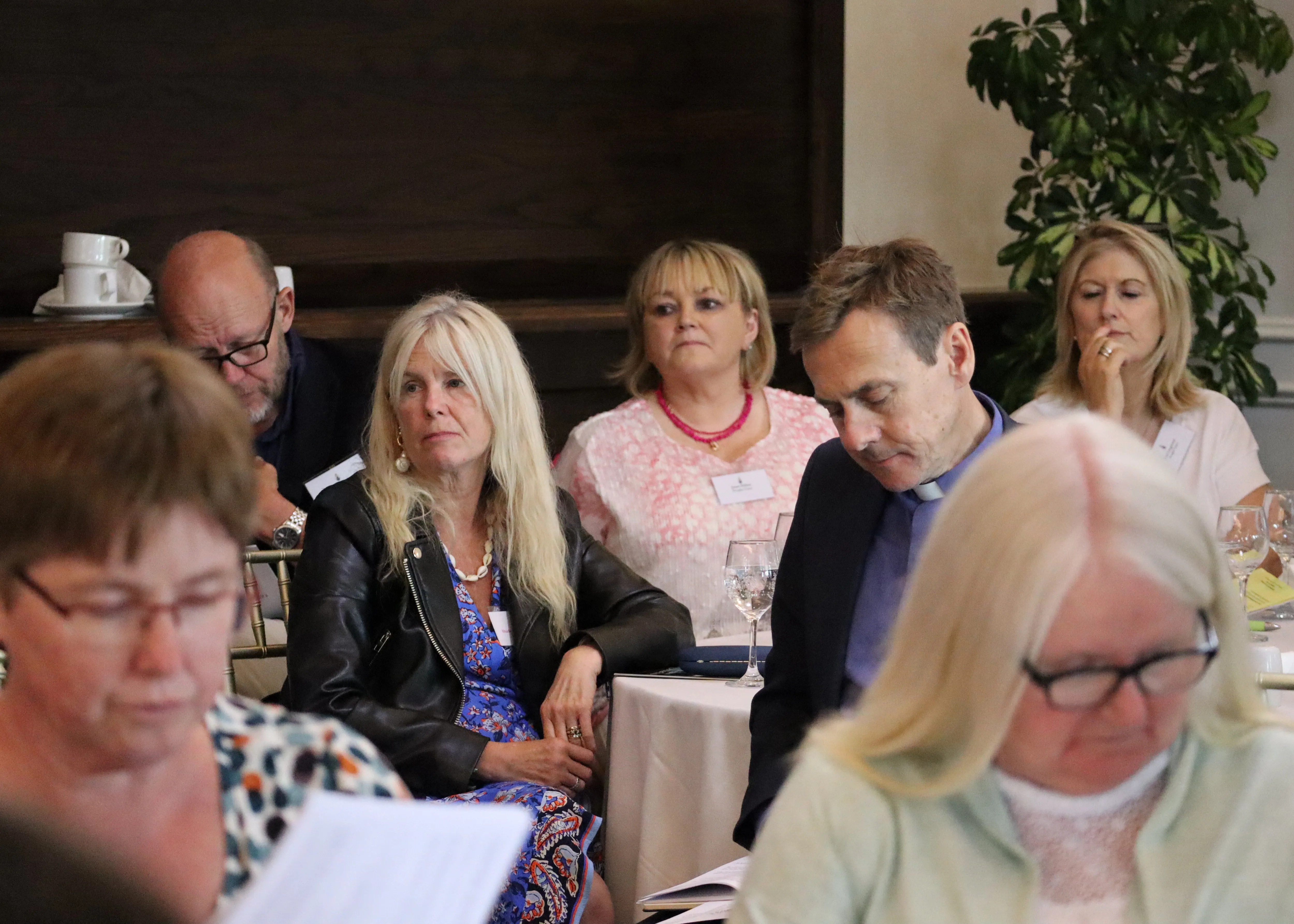
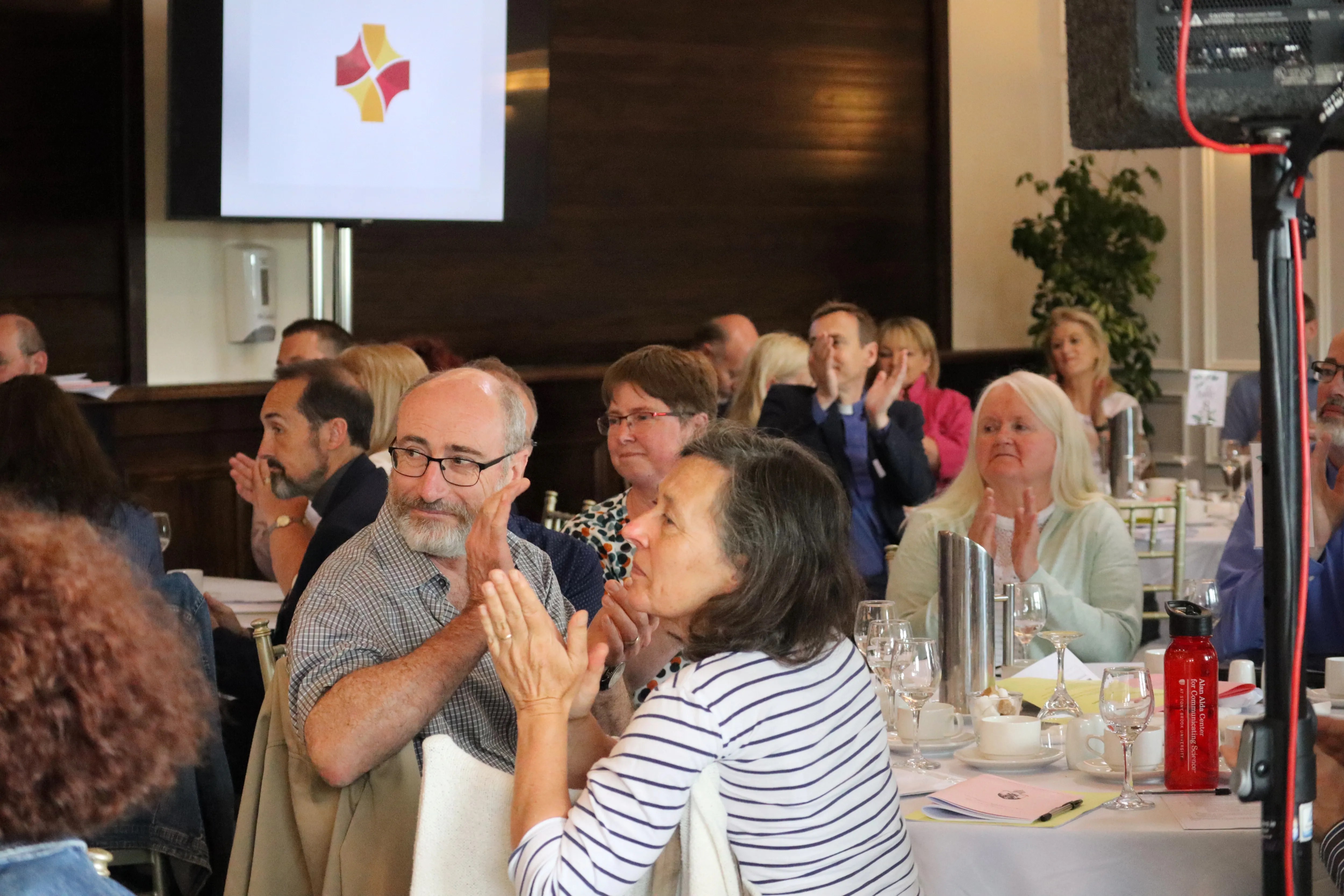
On Saturday, 17th June 2023, the United Dioceses of Cork, Cloyne and Ross held their Diocesan Synod at the Celtic Ross Hotel in Rosscarbery. The day started with a celebration of the Holy Eucharist in St Fachtna’s Cathedral, Rosscarbery. A quartet from the choir of St Fin Barre’s Cathedral, Cork sang at the service.
Cork, Cloyne and Ross Diocesan Synod at the Celtic Ross Hotel, Rosscarbery
At the Synod itself, the Bishop, the Right Rev. Dr Paul Colton took the President’s Chair at 11am and the Archdeacon of Cork, Cloyne and Ross, the Ven. Andrew Orr opened the proceedings with a reading and a prayer. The Diocesan Chancellor, Lyndon MacCann S.C. was unable to attend and Tim Bracken, B.L. was nominated as Assessor by the Bishop for this year’s Diocesan Synod. The Bishop welcomed special guests and a review video of images from the past months was played. Appointments, retirements, resignations and jubilees were noted and there was a minute’s silence was kept for all those who had died during the last year.
Bishop Colton’s Presidential Address can be read here. After words of thanks were spoken and everyone was encouraged to reflect upon the Presidential Address, the Archdeacon shared impressions from the General Synod of the Church of Ireland 2023 in Wexford. After this, the Rev. John Ardis proposed the Report of the Diocesan Council, which was seconded by Richard Wood. The Report was adopted unanimously. The Very Rev. Nigel Dunne proposed the reports of the Diocesan Board of Education and of the Diocesan Education Committee, and both were seconded by Peter Stobart. The reports were also adopted unanimously. The report of the Diocesan Youth Council was proposed by Oriel Hosford, seconded by Judy Peters and adopted unanimously.
The Rev. Rob Jones, Director of Pioneer Ministry for the Church of Ireland, gave a presentation on Pioneer Ministry and Patsy Devoy presented a video by the Church of Ireland Marriage Council. Andrew Coleman from Christian Aid Ireland spoke on the Burundi Project, which during its course raised €85,000 in Cork, Cloyne and Ross.
The Diocesan Synod ended with a hymn and a blessing from the Bishop.
Posted inDiocesan Synod, Diocese|Comments Off on Diocesan Synod of Cork, Cloyne and Ross 2023
The Bishop of Cork, Cloyne and Ross, the Right Reverend Dr Paul Colton, as President of the Diocesan Synod is pleased to publish the results of this year’s triennial elections, which have been reported to him by the returning officer, the Venerable Andrew Orr, Archdeacon of Cork, Cloyne and Ross. The votes cast at the Diocesan Synod on Saturday 17th June were counted today by the elected scrutineers.
Diocesan Trustees
The Bishop also reported to the meeting of the Diocesan Synod that Helen Arnopp had been elected on 25th May 2023 as a Diocesan Trustee to succeed John Stanley. The four Diocesan Trustees now are:
The Bishop
Helen Arnopp
Melvin Beamish
Linda Deane
Note: All election results which follow below are reported in the order of the election of the people concerned.
Diocesan Council
Clerical Members of Diocesan Council elected by the Clergy:
The Archdeacon, the Venerable Andrew Orr, (ex officio)
The Very Reverend Susan Green, Dean of Cloyne (Honorary Secretary, ex officio)
The Very Reverend Nigel Dunne, Dean of Cork
Canon Elaine Murray
The Reverend Robert Ferris
Canon Denis MacCarthy
Canon Alan Marley
The Reverend Abigail Sines
The Very Reverend Cliff Jeffers, Dean of Ross
The Reverend John Ardis
The Reverend Terry Mitchell
The Reverend Dr William Olhausen
The Reverend Meurig Williams
The Reverend Meghan Farr
Supplemental clerical members of Diocesan Council
Canon Dr Daniel Nuzum
The Reverend Kingsley Sutton
The Reverend Stephen McCann
The Reverend Anthony Murphy
The Reverend Richard Dring
The Reverend Ivan Ruiters
The Reverend Carole Pound
The Reverend Jean Carney
Lay members of Diocesan Council elected by the Laity
Linda Deane (Honorary Secretary – ex officio)
Dorothy Verplancke (Honorary Secretary – ex officio)
Graham Garland (Honorary Treasurer – ex officio)
Helen Arnopp (Honorary Treasurer – ex officio)
Hilda Connolly
Gordon Coombes
Andrew Coleman
Peter Stobart
Judith Peters
Dr Alicia St Leger
Richard Wood
Dr Simon Woodworth
Patricia Bogan
Carolyn Buttimer
Dorothy Beamish
Robin Newenham
Hilary Dring
Melvin Beamish
Heather Fleming
John C R Buttimer
Stephen Spillane
Supplemental lay members of the Diocesan Council
Tim Bracken
Eunice Jeffers
Emmanuel Adebisi
Sarah Louise Hockey
Dr Edward Gash
William Baker
Deirdre Bateman Roberts
Episcopal Electoral College
Clerical members of the Episcopal Electoral College elected by the clergy
The Venerable Andrew Orr, Archdeacon of Cork, Cloyne and Ross
The Reverend John Ardis
The Very Reverend Nigel Dunne, Dean of Cork
The Very Reverend Susan Green, Dean of Cloyne
The Reverend Robert Ferris
The Reverend Abigail Sines
Canon Alan Marley
The Very Reverend Cliff Jeffers, Dean of Ross
Canon Denis MacCarthy
The Reverend Meurig Williams
Canon Elaine Murray
The Reverend Terry Mitchell
Supplemental clerical members of the Episcopal Electoral College
The Reverend Dr William Olhausen
The Reverend Meghan Farr
Canon Dr Daniel Nuzum
The Reverend Richard Dring
The Reverend Kingsley Sutton
The Reverend Anthony Murphy
The Reverend Stephen McCann
The Reverend Ivan Ruiters
The Reverend Jean Carney
The Reverend Carole Pound
Lay members of the Episcopal Electoral College elected by the laity
Andrew Coleman
Gordon Coombes
Linda Deane
Dr Alicia St Leger
Helen Arnopp
Judith Peters
Melvin Beamish
William Skuse
Dorothy Verplancke
Hilda Connolly
Hilary Dring
Dr Simon Woodworth
Supplemental lay members of the Episcopal Electoral College
Peter Stobart
Eunice Jeffers
Dr Simon Elliott
Patricia Bogan
Richard Wood
Heather Fleming
Robin Newenham
Dr Edward Gash
Graham Garland
Tim Bracken
Representatives on the General Synod of the Church of Ireland
Clergy representatives on General Synod elected by the clergy
The Very Reverend Susan Green, Dean of Cloyne
The Venerable Andrew Orr, Archdeacon of Cork, Cloyne and Ross
The Reverend John Ardis
The Very Reverend Nigel Dunne, Dean of Cork
The Reverend Anne Skuse
The Reverend Robert Ferris
Canon Paul Willoughby
Canon Elaine Murray
The Reverend Kingsley Sutton
The Reverend Meghan Farr
The Very Reverend Cliff Jeffers, Dean of Ross
Canon Denis MacCarthy
The Reverend Dr William Olhausen
Supplemental clerical representative on General Synod
The Reverend Stephen McCann
Lay representatives on General Synod elected by the laity
Helen Arnopp
Andrew Coleman
Hilda Connolly
Linda Deane
Dorothy Verplancke
William Skuse
Gordon Coombes
Avril Jennings
Dr Alicia St Leger
Peter Stobart
Hilary Dring
Dr Simon Woodworth
Heather Fleming
Judith Peters
Ann Buttimer
Patricia Bogan
Richard Wood
Dr Simon Elliott
Tim Bracken
Stephen Spillane
Sylvia Helen
Richard Godsil
Robin Newenham
Eunice Jeffers
Graham Garland
John C. R Buttimer
Supplemental lay representatives on General Synod
Melvin Beamish
Dr Edward Gash
Guy St Leger
Richard Wood
Oriel Hosford
John de Montfort
Joan Jeffery
Vicky Coomber
Veronica Deane
Matt Gould
Margaret Skuce
Raymond Good
John Kershaw
Diocesan Committee of Patronage
Clerical members of the Diocesan Committee of Patronage elected by the clergy
The Very Reverend Susan Green, Dean of Cloyne
The Venerable Andrew Orr, Archdeacon of Cork, Cloyne and Ross
The Very Reverend Nigel Dunne, Dean of Cork
Canon Alan Marley
Supplemental Clerical members of the Diocesan Committee of Patronage
The Reverend John Ardis
Canon Elaine Murray
The Reverend Robert Ferris
The Reverend Meurig Williams
The Reverend Abigail Sines
Lay member of the Diocesan Committee of Patronage elected by the laity
William Skuse
Supplemental lay members of the Diocesan Committee of Patronage
Gordon Coombes
Dr Alicia St Leger
Andrew Coleman
Diocesan Board of Education
Clergy members of the Diocesan Board of Education elected by the clergy
The Reverend John Ardis
The Very Reverend Nigel Dunne, Dean of Cork
The Reverend Meghan Farr
The Very Reverend Cliff Jeffers, Dean of Ross
Canon Alan Marley
The Reverend Terry Mitchell
Canon Elaine Murray
The Venerable Andrew Orr, Archdeacon of Cork, Cloyne and Ross
The Reverend Anne Skuse
Lay members of the Diocesan Board of Education elected by the laity
Ian Coombes
Fiona Giles
Peter Stobart
Doris Bryan
Máire Roycroft
Dorothy Verplancke
Dr Edward Gash
Judith Peters
Olwen Anderson
Supplemental lay member of the Diocesan Board of Education
Stephen Spillane
Synod Representatives on the Diocesan Education Committee
The Reverend John Ardis
Olwen Anderson
Synod Representatives on the Diocesan Council for Mission
Clergy
The Very Reverend Cliff Jeffers, Dean of Ross
The Reverend Abigail Sines
Lay
Andrew Coleman
Sarah Louise Hockey
Synod Representatives on the Diocesan Youth Council
Clergy
The Very Reverend Cliff Jeffers, Dean of Ross
The Reverend Robert Ferris
Lay
Peter Coughlan
Oriel Hosford
Diocesan Court
Clergy
The Very Reverend Nigel Dunne, Dean of Cork
The Venerable Andrew Orr, Archdeacon of Cork, Cloyne and Ross
Dear esteemed members of the Cork, Cloyne, and Ross Diocesan Synod,
Grace and peace be with you all. It is with great joy and humility that I stand before you today as we gather for the 2023 Diocesan Synod. This Synod serves as a significant milestone in our journey of faith, unity, and service to the people of our beloved diocese.
First and foremost, I want to express my heartfelt gratitude to each one of you for your unwavering commitment to our shared mission. Over the past years, we have faced numerous challenges, but through our collective efforts and reliance on God’s guidance, we have persevered and continued to shine the light of Christ in our communities.
Artificial Intelligence
I did not write that introduction to my presidential address this year. No – it was written for me by Artificial Intelligence. I used the website OpenAI.com – OpenAI describes itself as an AI ‘research and deployment company with the mission to ensure that artificial general intelligence benefits all of humanity.’
What now follows is me, rather than it, whatever it is! This is my twenty-fifth presidential address to you at an annual Diocesan Synod in Cork, Cloyne and Ross. I haven’t yet completed a full 25 years as your bishop. That marker won’t be until next year. I have some thoughts about how to mark that silver jubilee in thanksgiving to God and in ways which will benefit the Diocese. I will share those ideas with you in the coming months having first, as ever, engaged in a time of consultation beforehand.
Returning to the AI – and I’m aware AI means something entirely different to many in our predominantly rural diocese – I am not referring to that, nor am I referring to the place in Canaan – Ai – mentioned in the book of Joshua (Joshua 7 and 8); the place which the Israelites only managed to conquer on their second attempt by setting up an ambush. In this context today it means artificial intelligence.
I believe it would be a very foolhardy person, one who knows little about these things, a person such as myself, to jump in dismissively or aggressively to rubbish artificial intelligence. In any case we are already dependent on it in so many ways every day. Nonetheless, I believe the emerging public debate about artificial intelligence can give us pause for thought and to revisit what we are actually about as a Church, and how we fulfil God’s commandments to us to love, and to go in God’s name to make disciples.
I remember a dear friend – a very far-seeing and visionary clergyman in the area of technology, very much ahead of his time, who, in late 1985, discouraged me from moving either to a computer with a Hard Disk or to the first generation of Microsoft Windows. He could not contemplate the possibility of Windows displacing MS-DOS (Microsoft Disk Operating System). ‘Hard disks are risky,’ he said. ‘Windows will never take off’ he said. Today Microsoft Windows has approximately a 78% share of the global market.
Similarly when I arrived in Dublin in 1990 and not long afterwards set up my first email account, I was at a clergy meeting and a senior clergyman in Dublin Diocese said to me mockingly ‘I suppose you have one of those new email thingies. It’ll never take off, you know. People won’t go with it!’ Instead, working a young parishioner, Craig McCauley, now the rector of Naas, County Kildare, we created what we believe was one of the first parish websites in Ireland, and then in 1999 this Diocese, launched what I believe was also one of the first, if not the first, website of an Irish Diocese on the internet. As a Diocese we have never been afraid to harness technology and information systems to save time and money, and to fulfil tasks efficiently and safely.
Again, back to AI – artificial intelligence. One should tread carefully when making deductions about the present and predictions about the future. As I say, AI is already well and truly here, and we all use it – perhaps unknowingly. Every time we do a Google search, click on something on Facebook or Instagram, buy a book from Amazon, book a trip – AI lurks in the background. The same is the case with food-ordering sites, music streaming services, online shopping, maps and navigation apps … the list is endless.
Then there are those vacuum cleaners and lawnmowers that make their own way around your house or garden. Tamagotchis – virtual pets – appeared on the scene in 1996 and became one of the biggest toy fads of the late 1990s and early 2000s. And I believe they are back! There are smart assistants such as Alexa and Siri to find answers to questions and to do things for us in our homes or in our cars. AI is there when we use our loyalty card, do our shopping, in the advertising and marketing that targets us, in e-commerce, in the world of finance, and in healthcare. In my car it tells me if I am too near the edge of the road, not in the middle of the lane, or if I need to stop to take a break. Some cars can drive themselves. My car reads the road signs and adjusts the speed of the car taking into account what vehicles and obstacles are near and around the car, and much more. AI is there in the ChatBots to assist us on websites. It translates languages for us instantaneously.
I say none of this by way of commendation; this is simply empirical observation. We all know that there are frustrations, limitations and very well-founded fears. These have featured much in the news and dialogue recently in the public space. Some of you, like me have, no doubt, been targeted on social media by artificial people – bots – short for robot – that mimic human activity and interactions. ‘People’ who are not in fact people often purveying opinions, propaganda and misinformation – honed especially for us according to our interests and activity. I found myself ‘picked out and picked off’ aggressively in the ligt of our support for refugees.
AI can fool us – remember recently ‘the Pope in a coat’. Last month, the New York Times reported that the British computer scientist, Dr Geoffrey Hinton, one of the most important figures in the history of artificial intelligence, known as the ‘Godfather of AI’, resigned from Google warning about tech’s threat to humanity. Undoubtedly there are very real existential risks here to which we need to be alert. Most of you are, at the end of the day, I suspect, like me – out of your depth when it comes to all this. There is a rush to regulate. That regulation doesn’t worry me at this juncture.
AI raises philosophical questions. Can a machine act intelligently? Can it solve any problem that a person would solve by thinking? Are human intelligence and machine intelligence the same? Can a machine have a mind, a mental state and a consciousness. Can it feel how things are?
AI raises theological questions. Is AI part of the evolution and unfolding of God’s creation? Where’s the human connection? What about our humanity? What about free will and the spiritual dimension? The Church has always adapted its understanding of humanity in the light of new knowledge. How will we respond to these technological developments in our own time? As ever there’s a risk that we won’t think and reflect, not only practically, but theologically, until we have already been carried along on yet another unstoppable wave of change.
We have to admit that again things seem less than certain and we are in the realm of mystery. AI raises questions about reason, personality, the soul, and there are ethical questions too. The Church’s track record in some of these debates is not good: Galileo in 1633, the Huxley-Wilberforce debate in 1860, and the Scopes ‘monkey’ trial in 1925, for example. In many great matters the Church has found itself on the wrong side of history, and in great matters has seldom been ahead of the curve.
Time does not permit me to explore the philosophical and theological dimensions of AI here; they are complex considerations. The risks associated with AI are much commented upon in the public space at the moment. Even as I type and say this, I am conscious that in the future someone, in a future context, may well quote this, and laugh their heads off.
Thankfully there are people reflecting and writing about all this. In Church Times Nick Spencer of Theos – a think tank in the UK which engages in research about the relationship between religion, politics and society in the contemporary world – Nick Spencer wrote an article recently entitled ‘Is artificial intelligence a threat to theology?’ And he pointed out a Cork connection – we love a Cork connection. He traces the digital revolution back to our own Queen’s College – now UCC – self-taught mathematician, George Boole and his Boolean Algebra which laid the foundations of the information age. Boole is buried in the churchyard at St Michael’s Blackrock. Spencer pointed out that one century after Boole’s work, the computer scientist John McCarthy coined the phrase ‘artificial intelligence’ in a paper he wrote for a conference in 1956.
I’ll pause for a moment and let you have a look at that cartoon from Church Times.
Provoked by Kirchentag AI Liturgy
What has provoked my focus this year on AI? How has it come about that these developments provide food for thought about our own ministry and mission? There’s the on-going public debate. Then, like some of you, I was stirred, in recent days by events at the German Kirchentag which was held in Nürnberg from 7-11 June.
The Kirchentag happens for five days in Germany every two years. It’s an assembly organised by the lay people of the German Evangelical – Protestant – Church. About 150,000 people attend each time. It was founded by lay people in 1949 in the wake of Nazi rule and the Second World War to strengthen democratic culture. It’s a free movement of people who are brought together by their Christian faith.
I have been to Kirchentag once. I went in 1991 at the invitation of Dr Simon Woodworth’s father, the late Dean David Woodworth, and Mary Woodworth (now Boyd). Canon Ian Ellis and Mrs Lesley Whiteside also travelled in our group. It was mind-expanding and enriching, exhilarating and inspiring in ways that I will tell you about another time. Suffice to say, it’s not often you see a football stadium – such as this one of Gelsenkirchen-Schalke – full of Christians for Sunday worship.
This year, however, a new experiment caught our eye and worldwide news. One Church – St Paul’s in Fürth in northern Bavaria, hosted a Church Service which was devised and presided over by artificial intelligence.
So what of artificial intelligence for Christians and in the Church? When you see the copies of the AI alternative to this address that I have for you, I hope you will agree that the artificial intelligence does not know you as I do, or as we all know each other. There is no mention of people, such as all those names I spent time focussing on before this address, their life journeys and concerns. There are challenges here for us. Ours is an incarnational faith – it needs us to be present, in person, as much as possible, together, with all our humanity, diversity, frailty and vulnerability. This is the way of Christ who ‘became flesh and lived for a while among us…’ (John 1)
The incarnation is key to our ministry. When we are inspired by the ministry of Jesus we see that nourished by prayer and times of solitude, he spent most of his time with people – not just followers, but opponents, and the most unlikely people on the margins of acceptable society. He touched people who were sick and comforted the bereaved. He sat down and ate with people, told them stories mostly inspired by their local context and circumstances. This is our model. Saint Paul wrote (Philippians 2.5-8):
5Let the same mind be in you that was in Christ Jesus,
6 who, though he was in the form of God,
did not regard equality with God
as something to be exploited,
7 but emptied himself,
taking the form of a slave,
being born in human likeness.
And being found in human form,
8 he humbled himself
and became obedient to the point of death—
even death on a cross.
A former priest of this Diocese – Rupert Moreton – now living and working in Finland, whose poetry can so often hit the nail on the head wrote this poem in recent days called Kirchentag:
The human machination glimmers where
a priest once stood as alter Christus, and
bemused, impressed, or horrified, they stare
at hubris that defies divine command
to touch and suffer, weep and mourn, confront
in Christ God’s flesh-real love, the sinews’ strain,
the stern embrace of truly human want,
surrender to the all-consuming pain
the shrinking remnant knows it can’t evade,
however hard the sad disciple’s path –
the path to liberation, carnal-made,
that springs from passion’s veil-rent aftermath.
The virtual manufactures incarnation;
demands from them their souls’ fell abdication.
I don’t have Rupert’s poetic skills. What I would say is that AI cannot visit you in your homes, so far at any rate – and I will never say never; as I said, that would be foolish. A bot cannot hold your hand when you are dying or lay hands on you for healing or confirmation. It does not know what is going on in your lives and communities unless we tell it or give it clues by allowing it to monitor us. It cannot be the water of baptism, or the body and blood of Christ in the Holy Communion. And so I could go on.
But it’s not enough simply to say that we are better in those ways, we have to demonstrate by doing them well that we are better than artificial intelligence by being the best communities in person, loving, showing compassion, visiting, engaging with human need, proclaiming the Gospel in ways sensitive to context while broadening horizons and expanding, with open arms, the boundaries of inclusion. One book title by Harris Bor caught my eye and I await its delivery: Staying Human: A Jewish Theology for the Age of Artificial Intelligence. It’s the ‘staying human’ bit that appeals to me in the context of our own faith.
When Jesus told us to love God and to love our neighbour, he meant something a lot more profound and life-changing than a Facebook like or an Instagram loveheart – those may make us and others feel good – but they do not absolve us in any way of God’s call to us to get up, to do and to be involved. Many have slithered into a virtual world of delusion, where they think they are joining in or even taking part by clicking on social media, when in fact they are not. Clicks online are not the same as gathering, going, attending, joining in, lending a hand, or getting stuck in. Remember the example Jesus gave – loving our neighbour is what the Samaritan did in that story. And alongside that great commandment at the end of his earthly ministry there was the great commission – he sent us to go and to make disciples, promising to be with us always. Again – going, proclaiming, not only in word, but in loving action.
All of this needs to be prioritised and be the core focus of our activity as we rebuild in the wake of the pandemic; the rebuilding that was so much of the focus of my address to you last year, and which continues now and will continue for some time still.
This isn’t about numbers, although those are not without relevance. It is about the quality and potential of church life, of gathering and participation, of pooling our gifts and resources, and faithfulness as disciples who are called, in the first instance, to assemble in response to God’s call, to worship, to gather around the Word and to receive the sacraments.
Census 2022
Speaking about numbers, I note that the Central Statistics Office has issued more information about last year’s Census. The Census 2022 Summary Results were published on 30th May. It is important to note that the full religion report won’t be issued until later this year: on 26th October 2023, in fact. This will give us more information about our own city and county as well as about each local electoral area.
In the meantime we now know that:
For the first time in 171 years Ireland’s population has exceeded 5 million people. This, naturally has huge implications for the fabric and infrastructure of our society in every sphere.
The average age of the population increased in the previous five years from 37.4 to 38.8. This has implications too, including for our churches.
There are lots of early insights about the social fabric of our communities. For example, the percentage of people over 15 years of age who are single increased from 41% of the population to 43%. The percentage of those who are married (including those who are remarried or in a same sex civil partnership) increased from 46% to 48%.
700,000 people indicated that they do voluntary work. No doubt that includes many of you: thank you! We are hugely dependent on our volunteers.
Ours is an increasingly diverse society. 12% of our population – 1 in 8 people – are of a nationality other than Irish. The largest groups come from Poland, the United Kingdom, India, Romania and Lithuania, followed by Brazil, Italy, Latvia and Spain. 20% of our population were not born in Ireland. All of this enriches our Church life and, yes, will change us in exciting and expanding ways.
When it comes to religion, there has been a lot of attention on particular percentages notably ‘no religion and ‘religion not stated’. No religion amounts to 14.29% of the population and another 6.7% did not state what their religion is for whatever personal reason. I was surprised that in the 2021 census in Northern Ireland the no religion category amounted to 17.3%. But the corollary of all that is that in some way, defining and affiliating themselves, with whatever degree of commitment, 79% of the people in this State are religious in some way. That’s a headline you never see ‘79% of the people in the country are in some way religious.’
As many of you know, one of my favourite quotations is that of Paul Brodeur who, among other things, writes for The New Yorker. He said ‘Statistics are human beings with the tears wiped off/away.’ My observations on the Census are not about statistics. They have human implications and are, therefore, of immense pastoral relevance and should motivate us to respond in Christ’s name.
Take this headline that I read in the Irish Examiner – ‘Number of over 65s living alone has jumped since the last census.’ This has and should have implications for how we minister to people in our communities. It should be one of the dynamics that shapes our pastoral work and our community life, and I am thinking about more than home visits. What do we do to offer opportunities to that age group living alone to get together and meet? Coffee after church can mean the world to people living alone. I know of a number of parishes where that age group for example, after Church have an ad hoc lunch club – going to a local carvery together, having worshipped first. In my Dublin parish other groups – youth group, uniformed youth organisations and Mothers’ Union, families took turns a few times a year, to cook and host a parish lunch.
Of import for us also in the Church of Ireland is that our number has barely changed at 124,749. When we add 219,788 Church members (again fewer than I anticipated) the overall Church of Ireland number on the island is 344,537..
Pioneer Ministry
This brings me to pioneer ministry. Many of us will be somewhat relieved that the overall membership of the Church of Ireland is much the same five years on, taking into account, no doubt, deaths, some new arrivals as part of the process of migration, as well as the departure, particularly of so many of our young adults, to spread their wings in foreign parts.
But should we be satisfied? Relief is not mission or growth. And what is our role in relation to the many people who say they have no religion. What are we doing in our place about the people who once came but no longer come or appear to have lost interest?
Pioneer Ministry is about reaching those who have little or no connection to Church. Shouldn’t this be a priority for all of us? The Reverend Rob Jones, National Director of Pioneer Ministry for the Church of Ireland is here today. Speak with him. I have invited him to address us shortly. He will be in the Diocese again on Tuesday afternoon 27th June to meet with those who have expressed an interest in talking about how this form of ministry can be implemented in our Diocese.
For starters, I, as Bishop, in consultation with you, need to identify three hubs. These hubs – three at most in our Diocese – are to be key group(s) of people in each diocese who will work with the Bishop, Pioneer Diocesan Advocate and the Pioneer Leadership Team to champion, advocate, support and drive pioneer ministry in your diocese . Pioneer Ministry Hubs will focus and help those people and ministries in each diocese that are reaching those with little or no connection to church. For this to happen we need to put into place ways of supporting pioneer ministry so that it is planned, credible, valued and released.
I will be working to identify these hubs, as I say, through consultation and making my recommendations on the basis of that information meeting with Rob Jones in ten days time. Rob will set out in detail what the roles of the hubs will be. If you wish to come along, please give your name today, during the lunch break, to my PA, Denise Stobart or sign up at the Pioneer Ministry stand.
Boiling it down in my own mind, crucial to reaching my decision about the three hubs, will be a simple question which I ask myself and ask you ‘Where in our Diocese are, on the one hand, the greatest number of people who have little or no connection with church, and, on the other, where is there the greatest potential and will, on the part of a group of individuals to be the hub, to make an effort to reach reach those with little or no connection with church?’
Decade of Centenaries
Several more focussed events are planned in our Cork, Cloyne and Ross Centenaries Commemoration and Reconciliation Programme. In its own way this was a fixed term project with a pioneering instinct. We recently marked the centenary of the end of the Civil War with our Diocesan Schools’ Service in St Peter’s Church Bandon. This has been a long programme and I want to thank everyone who engaged with the various events, of many kinds, that have taken place from the very start. If I am left with some overriding feelings they are these:
Nationally, the Expert Advisory Group on Centenary Commemorations charted, I believe, an inclusive, prudent and wise approach in leaving the majority of commemorations to local engagement and by charting a course that acknowledged the many traditions on this island.
Marking the centenaries has not tidied up, compartmentalised or resolved the debates, still often very heated, about our shared history.
Undoubtedly, there were flashpoints of controversy and contention, not quite reopening old wounds but illustrating that there is still more work to do in terms of mutual understanding, forgiveness and reconciliation. Churches should be to the fore in preaching and promoting these.
It is my incontrovertible experience as a pastor in this part of the world that the age of silence is not over. The inherited narratives within families and districts are still often very painful and many prefer to park them. I articulated this at a meeting in January at the Glencree Centre for Peace and Reconciliation when four representatives of minorities, of which I was invited to be one, were hosted in a round table discussion initiated by the descendants of those who signed the Anglo-Irish Treaty in 1922.
Are we trying to do too much?
Last year, in the wake of where we were in the Pandemic, I took, as I’ve already mentioned, the theme of rebuilding. In my Presidential Address 20 years ago – my fifth year as your bishop – I said
“Now that I’m in my fifth year as Bishop my sense of the Diocese is that too few people are trying to do too much. I make two propositions to challenge you:
We are trying to sustain too much infrastructure.
As a result we may be denying resources for the provision of new forms of ministry – our core activity, as I say.
I went on to speak about the number of churches, and the number of Services being offered throughout the Diocese on an average Sunday, as well as the human resources, yet alone the spiritual resources required to take all those services. I ventured to suggest that the rush around and the burden of so many services was ‘detrimental to our worship and community life.’
I concluded by saying:
‘The simple reality is that what we have at the moment and what we are trying to sustain is not sustainable in the way in which we are currently addressing it. This is most notable at a time of vacancy in parishes’.
Twenty years on, again at a time of significant number of vacancies, and as we face some stark facts about ministry alongside considerable opportunities, far too many of us have still not faced up to or engaged with this challenge. We need to do so prayerfully, realistically and selflessly, in a way that transcends our own parish and patch, and takes account of the total diocesan ecosystem.
Some Stark Facts about Ministry
What are those stark facts about ministry to which I refer? Life for me as bishop and for many of you, most especially those who have generously taken on additional roles as priest-in-charge, has been dominated in the past year by personnel moves and changes. You will have gathered this by the amount of time I spent earlier in this Synod acknowledging all the changes. In January, I hosted a vigil at Cloyne Cathedral which was very well supported to pray for vocations and vacant parishes and chaplaincies.
It is important that we all understand the current situation as it will impact on everyone, even in places which currently have their own minister. The ‘clusters of support’ model that I have developed with the support of the Diocesan Council will place expectations on everyone and require us all to make adjustments quite simply ‘to make things work.’
Earlier this week I surveyed my episcopal colleagues in order to ascertain the most up to date position which is:
There are currently 63 vacant incumbencies and chaplaincies in the Church of Ireland;
Of those, 6 are being temporarily provided for by alternative types of ministry;
This pattern of a significant number of vacancies is not new. It so happens that, in the wake of the pandemic, for one reason or another, we are more impacted at the present time than we have been for some time, although we have been in this boat before; it seems to be cyclical. I often draw the analogy with those puzzle games where one is supposed to move the pieces around to create a whole picture. Those puzzles are not easily done, and whatever one does, the gap moves around and is caused somewhere else. The picture is never entirely complete. I keep this exact set on my desk to remind myself of this.
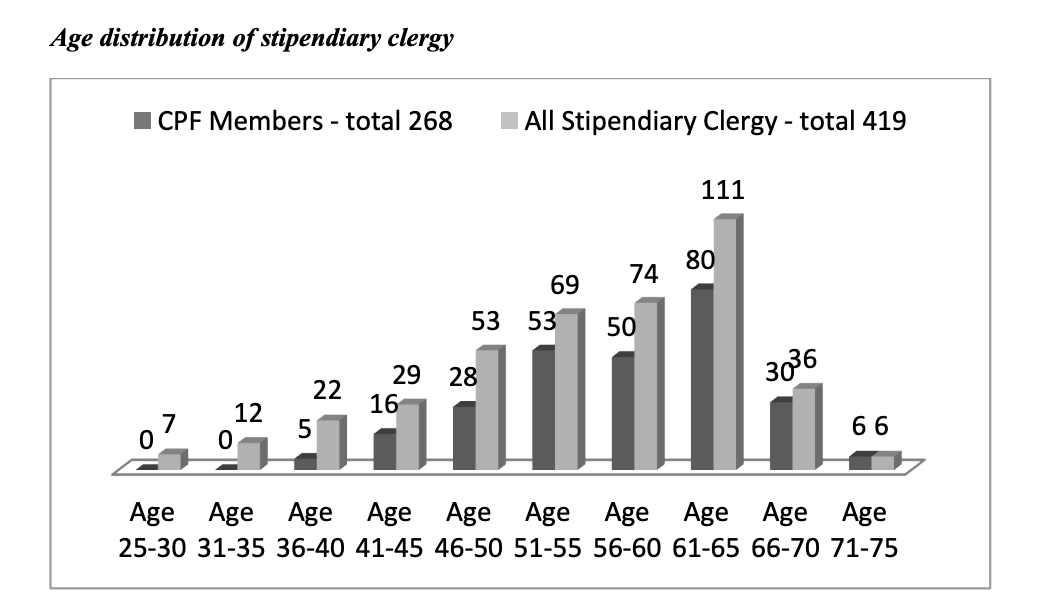
Then there is the age factor. One bishop told me that it is expected in their diocese that there will be ten more retirements between now and the end of the year. That shouldn’t surprise us. Members of the General Synod who have paid attention to the report of the Clergy Pensions Board will have noticed the ageing trend. Here is the table from this year’s book of reports:
There are 419 stipendiary clergy. Of those:
296 or 70.6% are 51 years of age or over.
153 or 36.5% are over the age of 60.
Just 7 or 1.7% are under 30.
41 or 9.8% are under 40
Another way of looking at that chart is this:
Approximately 37% of the current stipendiary clergy will retire within ten years;
Add five years and we can say that more than half – 54% – will retire within 15 years.
These figures alone show:
that we do face changes
the importance of nurturing vocations;
the need to reflect prayerfully about the implications for all of us; and of asking what God’s plan is for us in our ministry and mission;
and most of all, it will require strength of faith on all our parts, flexibility, openness to change, and a readiness to respond to uncertainty with courage and hope, and even to go into the unknown. But that should not threaten or surprise us, because in the Scriptures we see again and again, that God calls people to step out into the unknown, with the assurance that God is already there ahead of us to journey with us.
Personally, I cannot see ministry being fulfilled by artificial intelligence. I don;t think the robot, ‘Bless-U-2’ priest unveiled – also in Germany, in 2017 to mark the 500th anniversary of the Reformation is a way forward.
Charting a Future with Confidence
All of this again is where our re-engagement with Charting a Future with Confidence comes in. Unlike many other programmes Charting a Future with Confidence is not a manifesto where we will be told what to do. It is a process that requires us all to engage with challenges and opportunities, and to reflect on how we, in our own several places, need to implement change for the overall good.
It is better to manage change than to be at its mercy fatalistically or accidentally. There are very real challenges to face, not least in terms of ministry and resources.
Appeal for Flexibility and Openness to Change
What I do appeal for alongside realistic engagement, prayerful reflection, and confident faith, is a reasonable openness to change and for flexibility. I cannot guarantee that there will, for example, always be a Service in your parish at a traditional or usual time during a vacancy, or at the principal festivals of the year such as Easter or Christmas. Parishes need to be adaptable and to work with what human resources are available. We also have 76 places of worship in the Diocese. Most of them are not too far from another church, even in a neighbouring parish. There are also, on average, 64 church Services every Sunday in the Diocese – plenty of choice, particularly if we are dealing with a vacancy or an emergency.
Back to AI
As I conclude, let me again, turn to my anonymous artificially intelligent artificer of a presidential address:
As we embark on this journey together, I urge you to remember that we are all members of the body of Christ, with unique gifts and callings. Let us embrace unity amidst diversity, love amidst differences, and a shared commitment to the gospel amidst our individual journeys. May the Holy Spirit guide us, empower us, and renew us as we faithfully serve our diocese and strive to bring God’s kingdom on earth.
With sincere appreciation for your dedication, and with great anticipation for the blessings that lie ahead, I pray that this Synod will be a time of renewal, inspiration, and deepening of our faith.
May God’s grace abound in our deliberations and may our collective efforts bear fruit that will glorify His name.
It’s not at all bad, actually – but it’s not good enough and it’s not our way.
17th June 2023
The Right Reverend Dr Paul Colton, Bishop of Cork, Cloyne and Ross







 RSS - Posts